There are times when life can start to feel like a lot.
You might be getting everything done on the outside – going to work, studying, looking after family, seeing friends or keeping on top of everyday responsibilities – but inside you feel stretched. Your mind is busy, switching off is difficult and even something relatively small can start to feel like one thing too many.
Feeling overwhelmed doesn't always reflect how busy life looks from the outside. There can be a lot going on internally too – thinking, worrying, remembering, planning, anticipating – all of which can leave little opportunity to properly switch off.
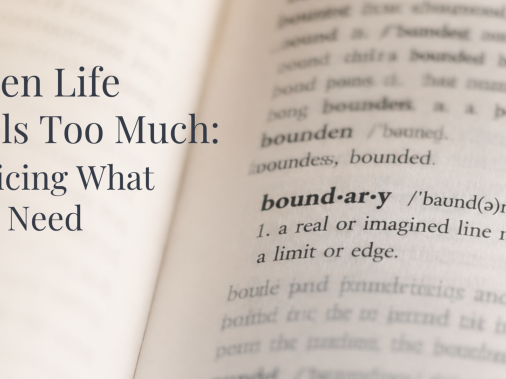
Over the past week, I've found myself reflecting on my own boundaries and what that word actually means to me.
When I hear the word boundary, I tend to think of a line – something quite fixed that marks where one thing ends and another begins. Yet my own personal boundaries don't always feel quite that straightforward.
What I need, what I have capacity for and what feels manageable can change. There are times when I am happy to give more of my time and energy and others when I need to pull back a little.
For me, recognising this starts with noticing what is happening. How am I feeling? What do I need? What do I realistically have the capacity for? Is there something that doesn't quite feel right?
Sometimes that noticing happens afterwards.
You might agree to go out when what you really wanted was an evening at home. You told yourself you weren't going to work over the weekend, yet somehow the laptop is open again on Saturday morning. Or you respond to another message when what you actually need is some time away from your phone.
Life involves compromise, responsibilities and doing things when we don't particularly feel like doing them. But when putting our own needs to one side starts to become a pattern, it can be worth noticing.
Why did I agree to that when I really didn't want to? Why is taking some time for myself so difficult? Why do I feel guilty when I do?
For young people, the circumstances may look different. There can be pressure to go along with friends when something doesn't feel quite right, to keep up with messages or to be available when they would really rather have some space. For some young people, having a sense of belonging and feeling part of a group can be important, and expressing a different need or opinion may not always feel straightforward.
The circumstances change as life changes, but putting ourselves into the equation isn't necessarily easy at any age.
Maybe you've become used to being the person who copes. The reliable one. The person who helps. The one who doesn't make a fuss.
There is nothing wrong with caring about other people, being flexible or sometimes putting somebody else's needs before our own. They are ordinary parts of relationships and life.
The difficulty can come when our own needs repeatedly disappear from the picture.
This is also where self-worth can come into the picture.
Where do my needs fit?
If I continually tell myself that I should be able to cope, that I'm making too much of something, that I'll rest later or that somebody else's needs are more important, what am I saying to myself about the importance of my own needs?
That doesn't mean finding it difficult to say no is automatically a sign of low self-worth, or that somebody who confidently says no has everything sorted. It isn't that simple.
But repeatedly overriding how we feel can take its toll. We may feel emotionally drained, frustrated or increasingly anxious. Switching off can become difficult and things we'd usually manage can begin to feel too much.
There can be many reasons for feeling overwhelmed or anxious. Personal boundaries aren't an explanation for everything, but they can be one part of the picture worth exploring.
This isn't necessarily about learning to say no more often. It might simply be recognising that you're tired, deciding something can wait, taking an evening to yourself or acknowledging that you don't actually want to do something.
What feels manageable will be different for everyone. Some personal limits can bend and adapt depending on what else is happening in our lives, while others may feel much more important or non-negotiable.
There isn't one right way to do this. The question is whether what we are asking of ourselves actually works for us.
What might counselling offer?
People don't necessarily come to counselling saying, "I need to work on my boundaries."
They may talk instead about feeling anxious, overwhelmed or exhausted, finding it difficult to switch off, putting themselves under pressure or feeling as though they have lost sight of what they need.
Counselling can offer a space to slow some of this down.
Rather than being told to simply set better boundaries, there can be space to explore what makes our own needs difficult to recognise or express in the first place. What am I worried might happen if I say no? Why does resting make me feel guilty? When did being the one who copes become so important?
There may not be a simple answer, and there doesn't have to be. Understanding why something feels difficult can be an important place to start.
Boundaries exist within counselling too. Sessions have an agreed beginning and end, there are clear limits around confidentiality and there is an understanding about how client and counsellor will work together. These boundaries aren't there to create distance; they help provide consistency and safety within the counselling relationship.
Reflecting on my own boundaries this week has brought me back to a very simple question.
When I'm thinking about what needs doing, what other people need from me and what I think I should be able to manage...
What about me?
Not because my needs are more important than anybody else's.
But because they are important too.